
I have radically rewritten this note on Romanian quotes. First, it reflects the decision to focus on the use of the quotes recommended by the Romanian Academy. Second, the note emphasizes the use of Unicode.
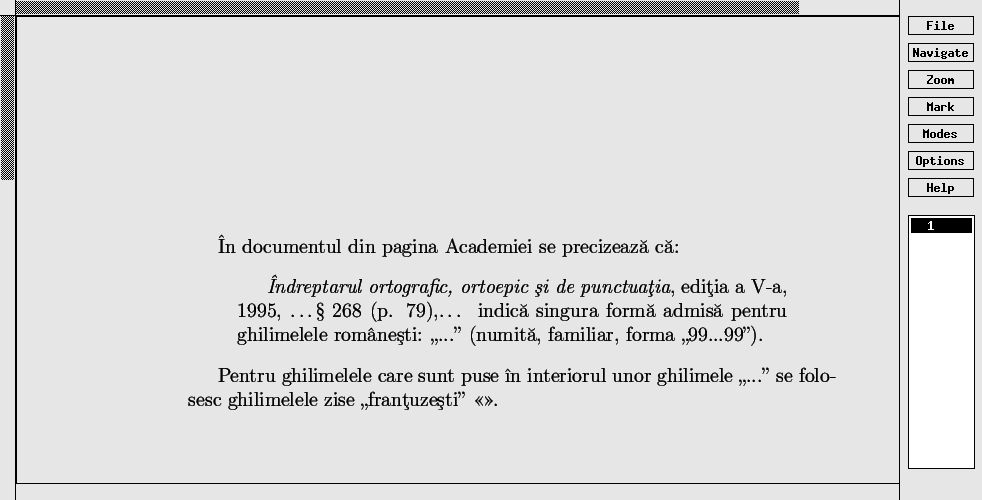
On the site of the Romanian Academy there is a note on the use of quotes in Romanian. It is a Word document! Difficult to read on the web and with technical recommendations only for Word!
The Romanian version of Wikipedia has adopted the recommendations of the Romanian Academy for quotes. Romanian publishing houses do follow also these recommendations.
As for Unicode, this is now a standard implemented in newer operating systems. This note is written under GNU/Linux Fedora Core 4, which uses Unicode.
I will start with the Unicode solution. This should be obvious from the following image of a LATEX source.
The dvi file shows how these quotes look like:
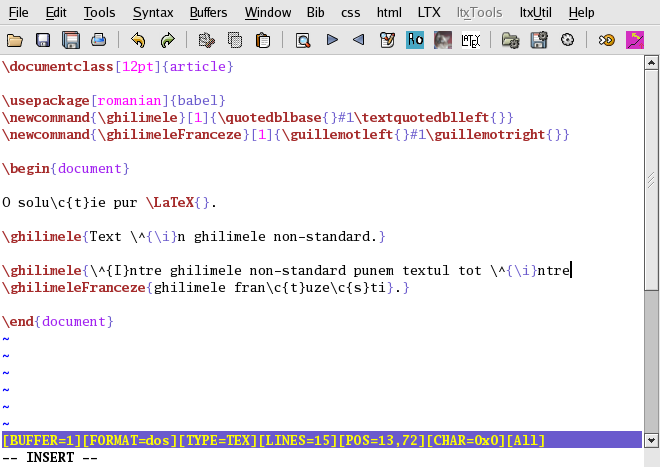
Now let's show the pure LATEX solution. No Unicode is involved this time.

The dvi file is as follows:

The advantage of the second solution is that it is easy to change the form of the quotes; one just have to change the relevant command.
The disadvantage is lesser readability of the source.
In the document of the Romanian Academy it is written that one may use however different quotes, on one condition: to use them in a consistent fashion.
Many old books and some publishing houses today use a form of the main quotes which might be called “99 ... 66”.
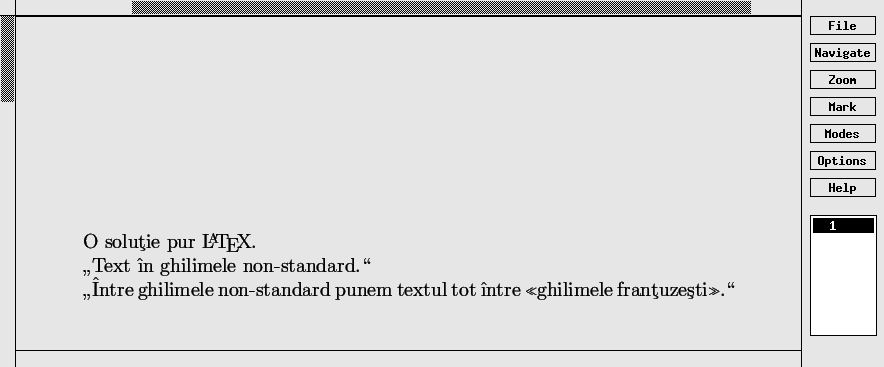
In Unicode the change is obvious. We show only the solution which does not use Unicode.
The dvi file is as follows:
The Wikipedia articles about quotations marks are not consistent. The English version of the list of quotation marks mentions the non-standard Romanian quotes. The German version mentions the Academy style quotes.
What should we use? The Academy quotes are standard and they should be used. It is easy to implement this solution with GNU/Linux and LATEX .
What is to be done if we have to change the quotes? Look for a solution at this note.